

This page is written for the skeptical reader. It covers the muscles involved, the two studies we rely on, and, just as important, what those studies cannot tell you.
Chapter 1
The anatomy in plain words
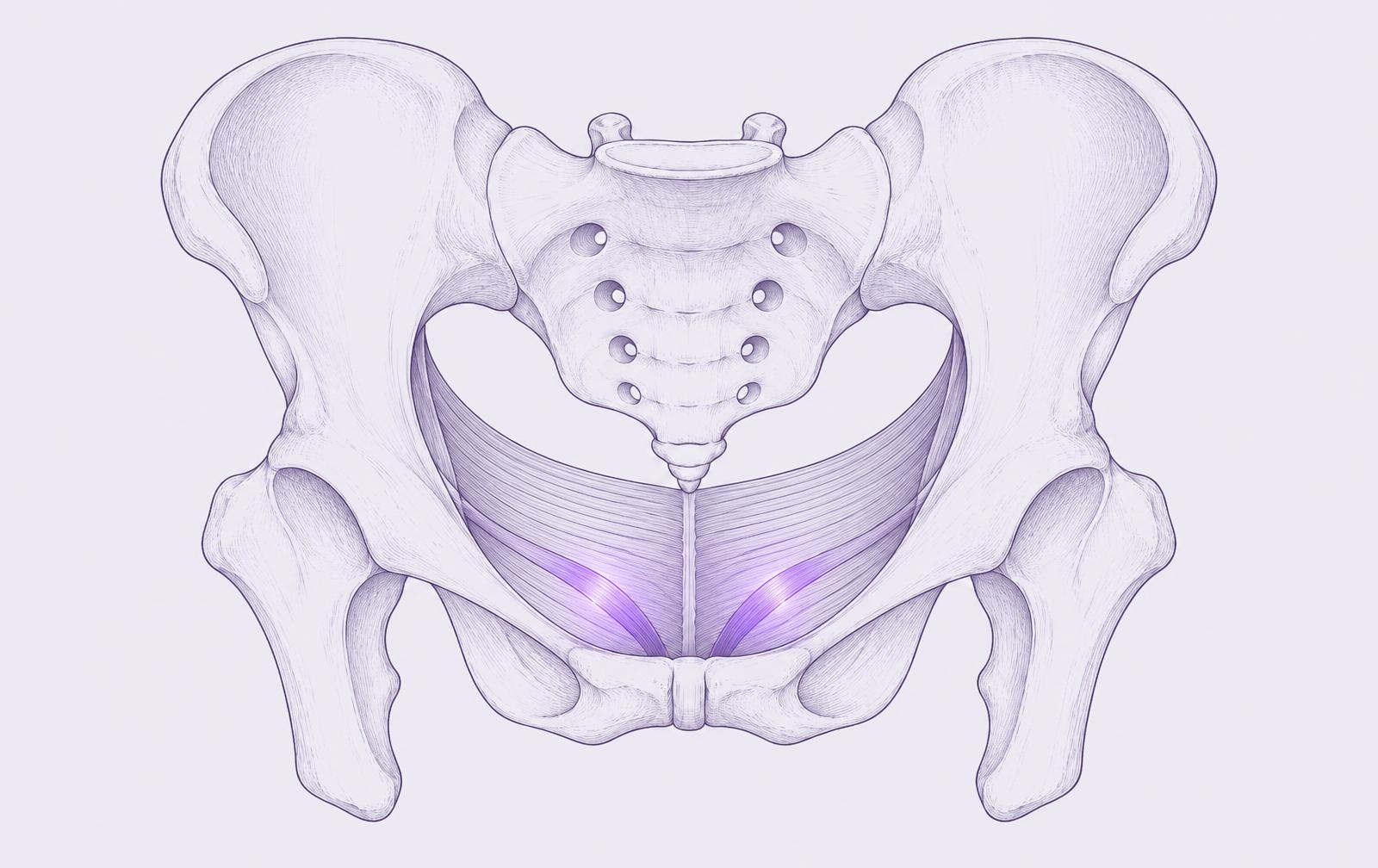
The pelvic floor is a sheet of muscle across the base of the pelvis. Two of its muscles matter most here.
Ischiocavernosus. It runs along each side of the base of the penis. When it contracts it compresses the crura, the internal roots of the erectile bodies, which raises pressure inside them. That pressure is what turns a filled erection into a rigid one.
Bulbocavernosus. It surrounds the bulb at the base. It helps keep blood in during an erection, and it is one of the muscles that contracts rhythmically in the ejaculatory reflex. It works in fast bursts rather than long holds, which is why fast repetitions are trained separately from endurance.
Chapter 2
Tense is a problem, not only weak
A muscle produces force by shortening from its resting length. A floor that is already held short has little range left, so it cannot generate much when it is needed, and it fatigues quickly.
A floor that never fully releases also tends to sit in a state of constant low level activity. That can show up as aching, urgency, or a sense of being on edge, and it makes the timing of a deliberate contraction harder rather than easier.
Adding contractions to a tense floor is the most common way this kind of training goes wrong. That is why week 1 is spent on releasing rather than squeezing.
Chapter 3
What studies found
- Reference 1
Dorey G, Speakman MJ, Feneley RCL, Swinkels A, Dunn CDR. Pelvic floor exercises for erectile dysfunction. BJU International, 2005.
A randomised trial in men with erectile dysfunction. One group did pelvic floor muscle exercises with biofeedback and lifestyle advice, the other received lifestyle advice alone. After the intervention period, the exercise group reported better erectile function than the control group, and a number of men regained normal function.
Limits of this study. The trial was small and ran in a single setting. Men were assessed on self-reported function, and the exercise group also received professional instruction, which the program here does not replace.
Link to the published paper pending verification.
- Reference 2
Pastore AL, Palleschi G, Fuschi A, et al. Pelvic floor muscle rehabilitation for patients with lifelong premature ejaculation: a novel therapeutic approach. Therapeutic Advances in Urology, 2014.
A pilot study in men with lifelong premature ejaculation who followed a pelvic floor muscle rehabilitation protocol over several weeks. Most participants who completed the protocol increased their intravaginal ejaculatory latency time compared with their own baseline.
Limits of this study. This was an uncontrolled pilot study with a small number of participants and no placebo group. The men were supervised in a clinic, and some dropped out before the end.
Link to the published paper pending verification.
These are the only studies cited on this site. We do not list a reference until someone on the editorial team has read the paper and checked that it says what we claim it says.
Chapter 4
What the research does not show
- Sample sizes are small. Both studies above involved modest numbers of men in single settings, which is a long way from proof at population level.
- Results vary between individuals. Some men in these studies improved a lot, some a little, and some not at all.
- Supervision differed. Participants were taught and monitored in a clinic. A self-guided program is not the same thing.
- Nothing here shows that training replaces medical evaluation. Erectile and ejaculatory symptoms can have causes that exercise does not address.
Chapter 5
How this maps to the program
- Release
- The ability to return the floor to resting length. Addresses the tension side rather than the strength side.
- Hold
- Endurance of the deep layer, the slow fibres that keep a position over time rather than producing a fast peak.
- Flick
- Fast response in the surface muscles, including the bulbocavernosus, which acts quickly rather than continuously.
- Ladder
- Graded control across part contractions, so a response can be dosed instead of switching between nothing and maximum.
Chapter 6
When to see a doctor
When to see a doctor first
Sudden onset of erectile problems, pain, blood in urine or semen, recent pelvic surgery, or symptoms together with chest pain or diabetes.
Erection changes can be an early sign of heart or metabolic conditions. A program like this does not replace that check.