Tight pelvic floor in men: signs and how to relax it
Key takeaways
- A tight (hypertonic) pelvic floor is one where the muscles stay contracted and do not let go, even when they should.
- It can show up as trouble starting to urinate, a feeling of not emptying fully, straining, pain in the pelvis or genitals, or pain with erection or ejaculation.
- A tense pelvic floor is hard to contract well, so it can behave like a weak one. Adding more Kegels does not deal with the tension and can make it worse.
- Relaxation starts with breathing: on each in-breath, let the belly soften and the pelvic floor loosen and drop.
- Prostate, bladder and bowel problems can cause the same symptoms. Lasting pain, fever or trouble passing urine need a doctor.
Most advice about the pelvic floor is about making it stronger. Some men have the opposite problem: pelvic floor muscles that stay tense and do not let go. This guide explains what a tight pelvic floor is, the signs to look for, why more Kegels can make it worse, and how to start relaxing it.
What a tight pelvic floor is
A tight pelvic floor, also called a hypertonic or overactive pelvic floor, is one where the muscles at the base of the pelvis are in spasm or held in a state of constant contraction. Muscles in that state cannot relax and coordinate properly (Cleveland Clinic).
Healthy pelvic floor muscles do two things. They contract when you need them to, and then they relax back to their resting position (University Hospitals Plymouth NHS Trust). A tight pelvic floor has lost the second half.
Why a tense pelvic floor acts like a weak one
When the pelvic floor is already tense, it is very difficult to contract it effectively (Royal United Hospitals Bath NHS Foundation Trust). So a tense pelvic floor and a weak one can feel much the same: the squeeze is small, it fades quickly, and control is poor. Our science page explains the muscles involved.
The fix is different, though. Adding strength work to muscles that are already tense does not deal with the tension and can make them tighter (Proactive Pelvic Health Centre).
Signs of a tight pelvic floor in men
Symptoms vary from man to man. These are the ones most often listed (Cleveland Clinic, University Hospitals Plymouth NHS Trust):
- Urinary. Difficulty starting or keeping up a stream, a sudden urge to urinate even when the bladder is not full, a feeling of not emptying fully, needing to go often, pain while urinating.
- Bowel. Difficulty starting a bowel movement, needing to strain, a feeling of not emptying completely, pain during or after.
- Pain. Pain or pressure in the pelvis, lower back or hips.
- Sexual. Pain during or after sex, erectile dysfunction, or pain with erection or ejaculation.
None of these is specific to a tight pelvic floor. Prostatitis, for example, can cause frequent and urgent urination, a weak stream and pain in the same areas (NIDDK). That is why these symptoms need a proper check rather than a guess.
Tight pelvic floor and chronic pelvic pain
Chronic prostatitis, also called chronic pelvic pain syndrome, is the most common form of prostatitis and affects 10% to 15% of men in the US. Its main symptoms last 3 months or more and include pain between the scrotum and anus, in the lower abdomen, penis, scrotum or lower back, and pain during or after ejaculation (NIDDK).
The pelvic floor seems to play a part. In a study of 62 men with chronic pelvic pain syndrome and 89 men without pelvic pain, the men with pain had more pelvic floor muscle spasm, higher muscle tone and more tenderness. Strength testing showed no difference between the groups. The authors concluded that problems in the pelvic muscles may contribute to the pain (Hetrick et al., 2003).
The exact cause of chronic pelvic pain syndrome is not known, so it needs a doctor's assessment. Treatment can include physical therapy such as myofascial release of the pelvic muscles, biofeedback and relaxation exercises (NIDDK).
What can cause it
Cleveland Clinic lists these causes and risk factors (Cleveland Clinic):
- habitually holding in urine or stool
- injury or trauma to the pelvic muscles, for example during surgery
- prolonged sitting, poor posture or an irregular walking pattern
- other pain conditions in the area, such as irritable bowel syndrome
- a history of physical or sexual abuse
- stress, anxiety and depression
Tension often builds without you noticing. Part of the work is learning to notice when you are holding the pelvic floor tight, and to recognise that this is not its normal resting state (University Hospitals Plymouth NHS Trust).
Why more Kegels are not the answer
If your pelvic floor is tight, squeezing harder and more often adds to the tension (Proactive Pelvic Health Centre). NHS relaxation programmes start with learning to let go. Strengthening comes back in once that is reliable, by relaxing the pelvic floor on the in-breath and contracting it on the out-breath (University Hospitals Plymouth NHS Trust).
Our guide to Kegel exercises for men follows the same idea: every squeeze ends with a full release, and the rest is as long as the hold.
Not sure where you are starting from? Take the 3-minute quiz.
How to start relaxing your pelvic floor
These exercises come from NHS physiotherapy leaflets. They are gentle and should not hurt. Stop if anything causes pain.
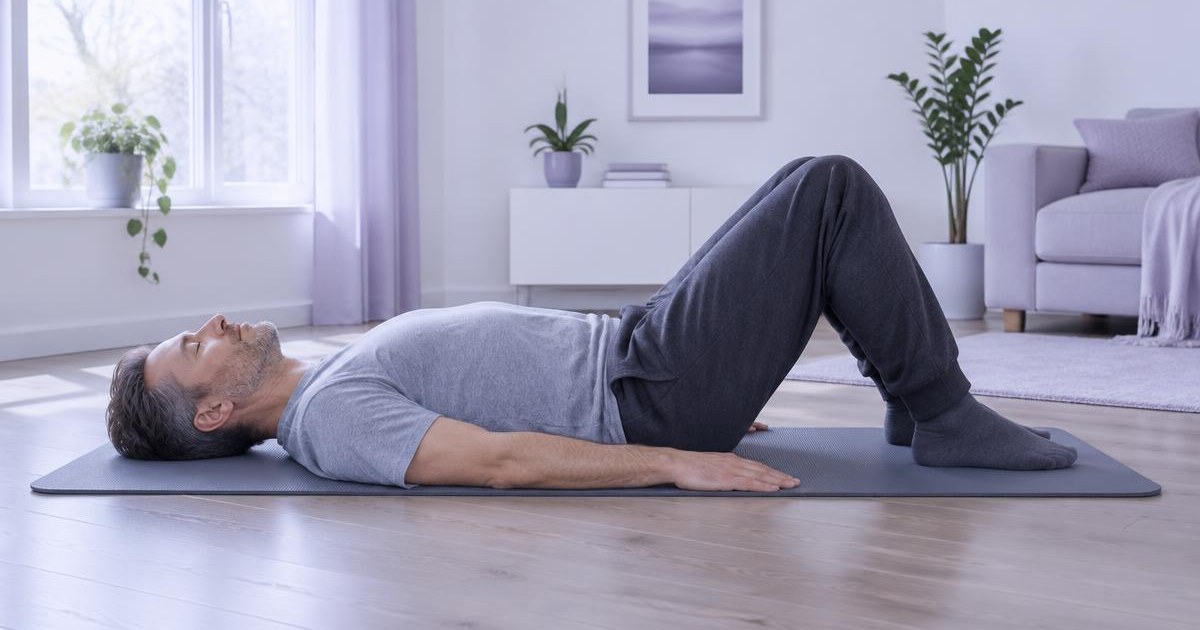
1. Belly breathing. Lie on your back with your knees bent, or sit comfortably (Royal United Hospitals Bath NHS Foundation Trust). Put one hand on your chest and the other on your belly. Breathe in slowly through your nose and let your belly soften and gently rise. Breathe out and let your ribs and belly fall back to rest. Work up to breathing in for a count of 4 and out for a count of 4 (University Hospitals Plymouth NHS Trust).
2. Sniff, flop and drop. This is the reverse of a Kegel. Breathe in through your nose for about 3 seconds, let your belly flop outwards, and let the pelvic floor muscles go (University Hospitals Plymouth NHS Trust). It can help to picture your sit bones gently spreading apart and your tailbone floating back as you breathe in, then coming back together as you breathe out (University Hospitals Plymouth NHS Trust, Royal United Hospitals Bath NHS Foundation Trust).
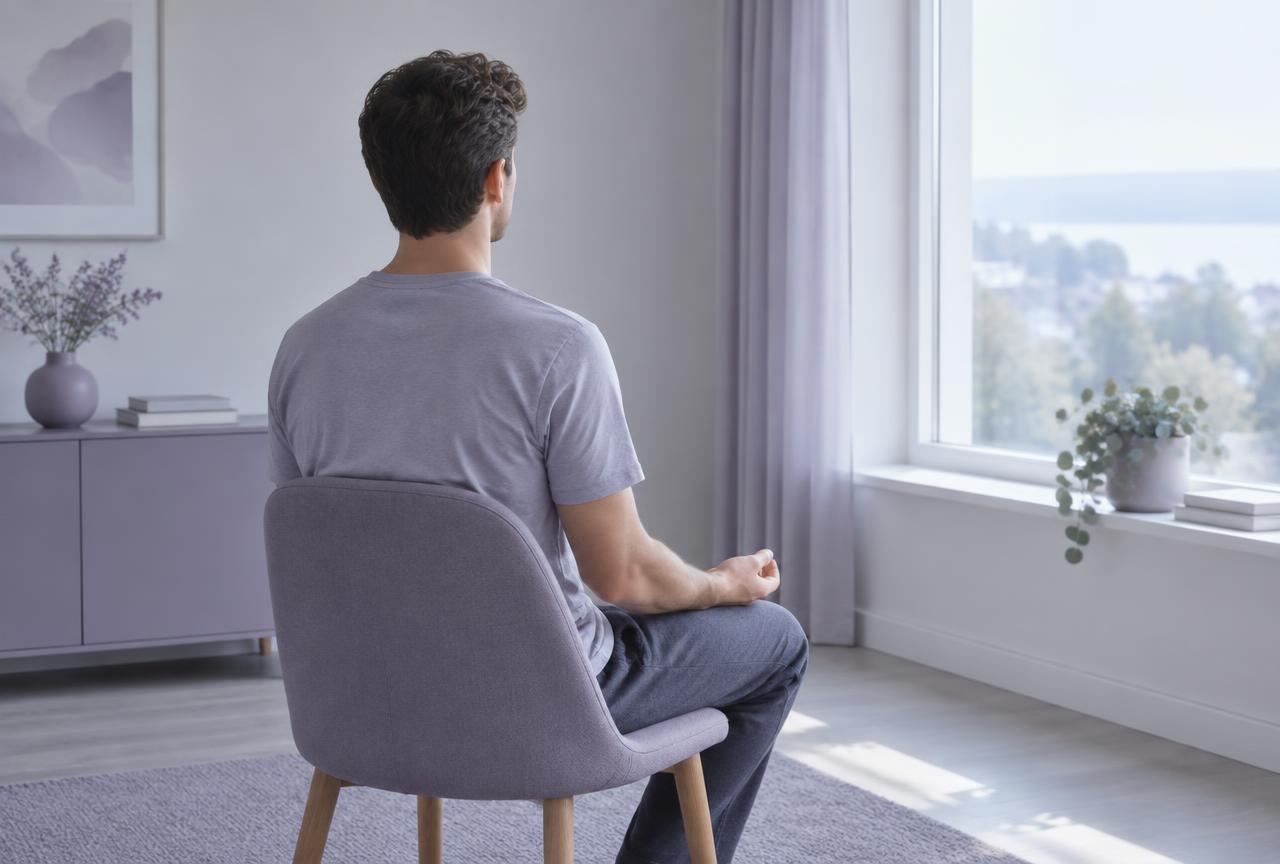
3. One-minute seated reset. Sit with your knees uncrossed and your feet apart on the floor. Let your jaw soften and your belly relax. Breathe down into your waist and let the pelvic floor soften and loosen. Once you can do it, use it at different times of the day (University Hospitals Plymouth NHS Trust), for example when you notice you are clenching.
4. Gentle stretches with slow breaths. Hold each position for 5 to 10 belly breaths, picturing the pelvic floor opening a little more on each in-breath (Royal United Hospitals Bath NHS Foundation Trust):
- lying on your back with the soles of your feet together and your knees falling out to the sides
- lying on your back and hugging one knee towards your chest, then the other
- lying on your back holding the outside edges of your feet, knees wide, rocking gently from side to side
5. Everyday habits. Avoid holding in urine or stool and avoid straining (Cleveland Clinic). Cleveland Clinic lists prolonged sitting among the causes, so it is worth breaking up long spells at a desk, and it also suggests mindfulness and relaxation techniques (Cleveland Clinic).
When to see a pelvic floor physiotherapist
A pelvic floor physiotherapist (a pelvic floor physical therapist in the US) can examine the muscles and tell you whether tension, weakness or both are the problem. Treatment can include biofeedback to learn to contract and relax the muscles correctly, relaxation techniques for the pelvis and abdomen, massage, stretching and joint movement (Cleveland Clinic). This approach is often called down-training, with the focus on pelvic floor awareness, relaxation exercises, trigger point release and stretches (Aw et al., 2017).
The evidence is still limited. In a small randomised trial in men and women with chronic pelvic pain, 57% responded to up to 10 weekly 1-hour sessions of myofascial physical therapy aimed at the pelvic floor and surrounding muscles, compared with 21% after general massage (FitzGerald et al., 2009).
When to see a doctor
See a doctor if:
- you have pain in the pelvis, genitals or lower back that keeps coming back, or pain during or after ejaculation (NIDDK)
- you have trouble starting to urinate, a weak stream or you need to go often (NIDDK)
- you notice blood in your urine or semen
- your erections have changed, since erection problems can be an early sign of heart disease (Mayo Clinic)
Get medical help straight away if you cannot pass urine at all, or if you need to urinate painfully, often and urgently and also have a fever and chills (NIDDK).
If you want a structured start, Adaging's plan begins with a week focused on release, and every session opens and closes with letting go. It takes 5 to 10 minutes a day, and the quiz takes 3 minutes.
Frequently asked questions
Sources
- Hypertonic pelvic floor. Cleveland Clinic.
- Pelvic floor relaxation. University Hospitals Plymouth NHS Trust.
- Relaxing the pelvic floor. Royal United Hospitals Bath NHS Foundation Trust. 2021.
- Prostatitis: inflammation of the prostate. National Institute of Diabetes and Digestive and Kidney Diseases (NIDDK).
- Musculoskeletal dysfunction in men with chronic pelvic pain syndrome type III: a case-control study. Hetrick DC et al. The Journal of Urology. 2003.
- Randomized multicenter feasibility trial of myofascial physical therapy for the treatment of urological chronic pelvic pain syndromes. FitzGerald MP et al. The Journal of Urology. 2009.
- Overactive pelvic floor muscles (OPFM): improving diagnostic accuracy with clinical examination and functional studies. Aw et al. Translational Andrology and Urology. 2017.
- To Kegel or not to Kegel?. Proactive Pelvic Health Centre, Toronto.
- Erectile dysfunction: A sign of heart disease?. Mayo Clinic.
Adaging is an educational wellness program. It is not medical advice and does not replace a consultation with a doctor.
Adaging Editorial Team
We write from published research and clinical guidelines, and we say what the evidence does not show. How we write and check our content