
Kegel exercises for men: a step-by-step guide
Key takeaways
- Kegels train the pelvic floor, the muscle group that supports bladder and bowel control, helps keep an erection firm and takes part in ejaculation.
- Find the muscles first. In a mirror, the base of the penis should draw in and the testicles lift, while your belly, buttocks and thighs stay relaxed.
- Most guides suggest 3 sets a day, starting with 3-second holds and a full release after each, and building towards 10-second holds.
- Letting go matters as much as squeezing. Muscles that stay tense cannot relax or coordinate well, and more squeezing can make them tighter.
- The main studies in men measured results after about 3 months. Erection problems that start suddenly, pain, or blood in urine or semen need a doctor first.
Kegel exercises train the pelvic floor: you squeeze and lift the muscles at the base of the pelvis, then let them fully relax. The exercise is simple, but many people get it wrong at first. This guide covers how to find the right muscles, how to do the exercise, how many to do a day, how long it takes, and what the research in men shows and does not show.
What the pelvic floor does in men
The pelvic floor is a layer of muscle between the pubic bone at the front and the tailbone (coccyx) at the back. It supports the bladder and bowel and helps you control when you pass urine or empty your bowels (NHS). In men it has two more jobs.
Erections. The muscles at the front of the pelvic floor help keep blood in the penis once it has filled, which makes the erection firmer (Pelvic Floor First). Two of them, the ischiocavernosus and the bulbocavernosus, raise the pressure inside the erectile tissue. The bulbocavernosus also presses on the vein that drains blood out of the penis (Dorey et al., 2004).
Ejaculation. Some of the same muscles contract rhythmically at climax. They also squeeze out the last drops of urine after you urinate (Pelvic Floor First).
A Kegel is a deliberate squeeze and lift of these muscles, followed by a full release. Our science page goes deeper into the anatomy.
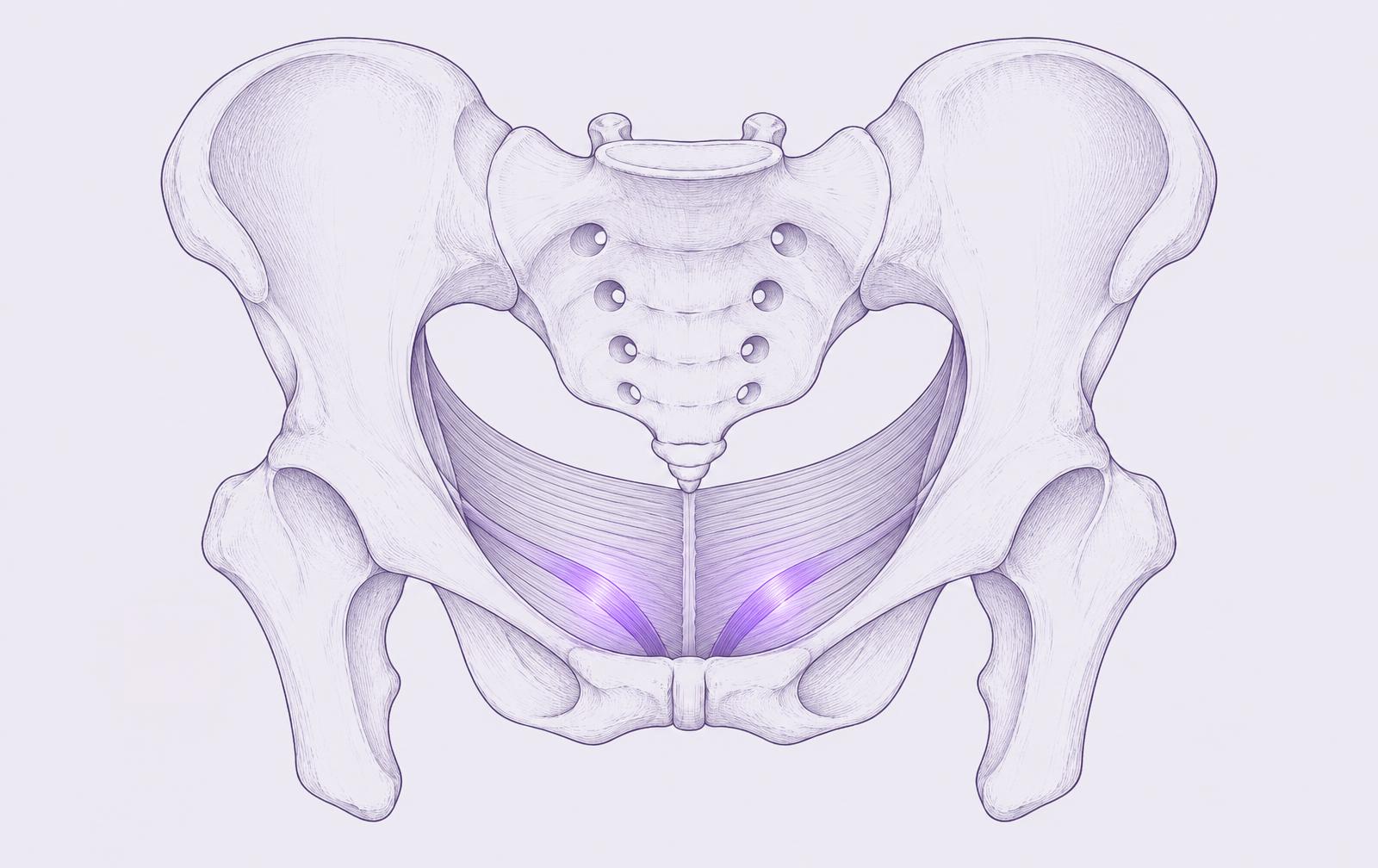
Schematic. The pelvic floor across the base of the pelvis, with the two muscles described above highlighted.
Who might benefit from Kegels
Mayo Clinic describes Kegel exercises for men as a way to improve bladder control and possibly sexual performance (Mayo Clinic). They are worth considering if you have:
- Dribbling after urination. In a trial of 55 men with erectile dysfunction, 36 of them (65.5%) also had dribbling after urination. Exercises that included a strong squeeze straight after urinating reduced it significantly at 3 months (Dorey et al., 2004).
- Leaks or weaker bladder control. Age, diabetes, an overactive bladder and prostate surgery can all weaken the pelvic floor (Mayo Clinic Health System). After prostate surgery, follow the plan from your surgical team or physiotherapist.
- Changes in erection quality. A randomised trial found improvement in many men with erectile dysfunction. The details and limits are below.
- Finishing sooner than you want. A small uncontrolled study found improvement in men with lifelong premature ejaculation. Also covered below.
Constipation, being overweight, heavy lifting (including weights at the gym) and a long-lasting cough can all weaken these muscles (Australian Government Department of Health).
How to find your pelvic floor muscles
About 40% of people do not do a Kegel correctly the first time, according to Mayo Clinic Health System (Mayo Clinic Health System). Use one or more of these checks before you start.
The mirror check. Stand in front of a mirror without clothes. Tighten as if you were stopping the flow of urine and holding in wind (gas) at the same time (NHS). The base of the penis should draw in slightly and the testicles should lift. When you relax, you should feel a clear sense of letting go (Pelvic Floor First, Continence Health Australia).
The fingertip check. Place your fingertips on the skin just behind the scrotum. When you squeeze, the area should tighten and lift away from your fingers (NHS).
The stop-the-flow test. Midway through urinating, try to slow or stop the stream. If you can, you have found the right muscles. Try it once or twice at most. Doing it regularly can disrupt how your bladder empties (Continence Health Australia).
In every check, your belly, buttocks and thighs should stay relaxed, and you should keep breathing (Mayo Clinic). If you cannot feel a clear squeeze and lift, or see no movement in the mirror, a pelvic floor physiotherapist (a pelvic floor physical therapist in the US) can check your technique, often with biofeedback (Australian Government Department of Health, Pelvic Floor First).
Not sure where you are starting from? Take the 3-minute quiz.
How to do Kegel exercises, step by step
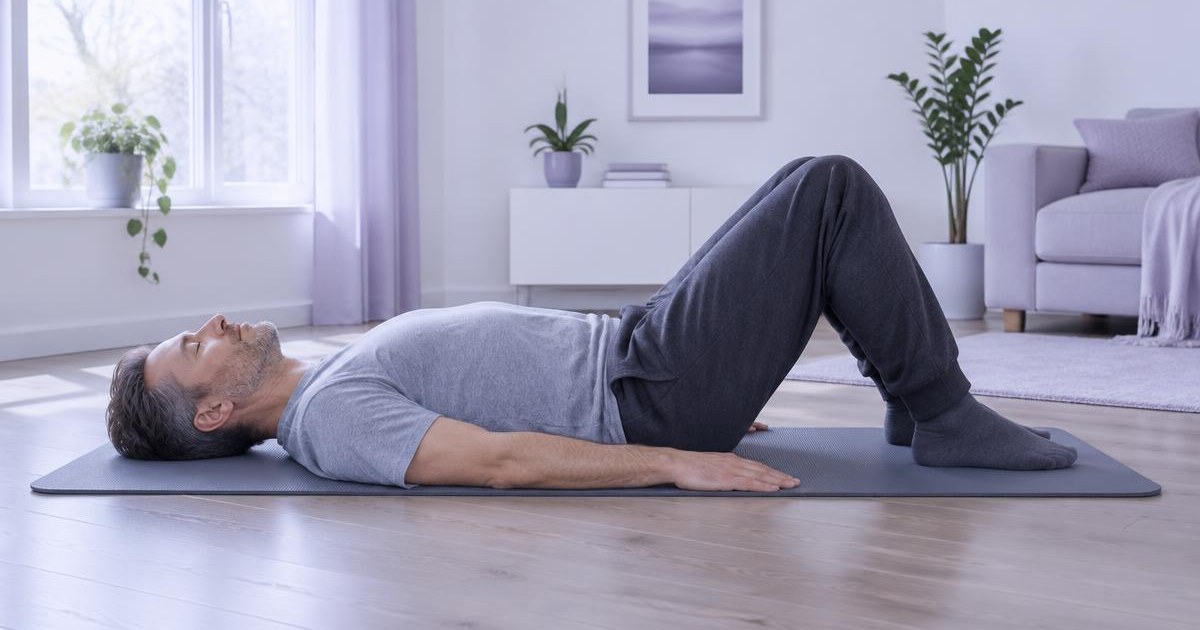
- Get comfortable. Empty your bladder first (MedlinePlus). Lie on your back, or sit with your feet flat on the floor and your back supported (Cleveland Clinic). Many men find lying down easiest at first (Mayo Clinic).
- Relax the muscles around it. Let your shoulders, belly, buttocks and thighs go soft (Continence Health Australia).
- Breathe out and lift. As you breathe out, squeeze and lift as if stopping urine and wind at the same time (NHS).
- Hold for 3 seconds (Mayo Clinic, Continence Health Australia). Keep breathing. Counting out loud helps you avoid holding your breath (Cleveland Clinic).
- Let go completely. Rest for at least as long as you held, or for one full breath, until the muscles feel fully relaxed (Continence Health Australia, Mayo Clinic Health System).
- Repeat. Start with 3 to 5 squeezes in a set and build towards 8 to 10 (Continence Health Australia).
- Add quick squeezes, if you like. After the slow holds, you can add 3 to 5 quick squeeze-and-release reps, building towards 8 to 10 (Continence Health Australia).
- Change position as you improve. Once the exercise feels easy lying down, practise sitting, then standing, then walking (Mayo Clinic).
Over the following weeks, lengthen the hold towards 10 seconds and keep the rest as long as the hold (Cleveland Clinic, Mayo Clinic Health System).
How many Kegels should a man do a day?
Guides differ in the details but agree on the shape: a few short sets spread across the day, slow holds with full rests, and gradual progress.
- Mayo Clinic suggests at least 3 sets a day, working up to 10 to 15 squeezes in each (Mayo Clinic).
- Cleveland Clinic suggests 3 sessions a day of 10 squeezes, building towards 10-second holds with 10-second rests, and stopping when you get tired (Cleveland Clinic).
- Continence Health Australia suggests 3 sets a day, building from 3 to 5 squeezes held for 3 seconds towards 8 to 10 squeezes held for 5 to 8 seconds (Continence Health Australia).
The stages below combine these ranges. Keep to 3 sets a day throughout, and move up a stage only when the current one feels clean.
| Stage | Hold | Rest | Squeezes per set | Move up when |
|---|---|---|---|---|
| Start | 3 seconds | At least 3 seconds | 3 to 5 | Every squeeze lifts and fully releases |
| Build | 5 to 8 seconds | As long as the hold | 8 to 10 | The lift holds to the end of every set |
| Longer holds | Up to 10 seconds | As long as the hold | 10, plus optional quick squeezes | Keep this as your routine |
If the lift fades before the end of a set, stop the set there. A clean lift and a full release on every squeeze count for more than the number of squeezes.
Why letting go matters as much as squeezing
Not every man has a weak pelvic floor. In some men the muscles stay contracted most of the time, a condition called a hypertonic pelvic floor. Muscles held in that state cannot relax or coordinate properly, and in men it can show up as erection problems or pain with erection or ejaculation (Cleveland Clinic). Pelvic floor physiotherapists point out that adding strength work to muscles that are already tense does not deal with the tension and can make them tighter (Proactive Pelvic Health Centre).
That is why every squeeze in this guide ends with a full release, and why the rest is as long as the hold. If you find it hard to let go after a squeeze, or the exercises cause pain, stop and see a doctor or a pelvic floor physiotherapist. They can check whether tension or weakness is the problem (Cleveland Clinic).
If you think your pelvic floor may be tight, read our guide to a tight pelvic floor in men.
Common mistakes
- Holding your breath. Breathe normally throughout (Mayo Clinic).
- Squeezing the wrong muscles. Your belly, buttocks and thighs should stay relaxed (Mayo Clinic).
- Bearing down instead of lifting. A correct squeeze lifts, with relaxed breathing and a soft belly. Over-tightening tends to bring breath-holding with it (Canberra Health Services). If it feels like straining, start again with a gentler squeeze.
- Skipping the release. Rest for as long as you held (Continence Health Australia).
- Making the stop-the-flow test a habit. Use it once or twice to find the muscles, then leave it (Continence Health Australia).
- Training through fatigue. When the squeeze gets weak or sloppy, the set is over (Cleveland Clinic).
- Stopping after two weeks. The studies below measured results after about 3 months.
How long do Kegels take to work?
Expect it to take months. The authors of the main trial in men with erectile dysfunction concluded that the exercises should be properly taught and practised for at least 3 months, followed by a maintenance routine (Dorey et al., 2004). The premature ejaculation study measured its results after 12 weeks (Pastore et al., 2014), and the trial on dribbling after urination at 3 months (Dorey et al., 2004).
The first thing to aim for is better control of the muscle itself: a clear lift, a clean release and longer holds. In the erectile dysfunction trial, erectile function had improved at 3 months and improved further by 6 months (Dorey et al., 2004).
What the research shows, and what it does not
Erectile dysfunction. In a randomised trial, 55 men with erectile dysfunction either learned pelvic floor exercises from a physiotherapist, with biofeedback and lifestyle advice, or received lifestyle advice only. After 3 months, erectile function was significantly better in the exercise group (Dorey et al., 2005). Men in the control group who had not improved were then given the same exercises. At the final blinded assessment, which covered all 55 men, 40% had regained normal erectile function, 34.5% had improved and 25.5% had not improved (Dorey et al., 2004).
Premature ejaculation. An uncontrolled study followed 40 men with lifelong premature ejaculation, whose time to ejaculation during intercourse was one minute or less at the start. They had 12 weeks of pelvic floor rehabilitation. At the end, 33 of the 40 men (82.5%) had gained control of the ejaculatory reflex, and their average time to ejaculation was 146.2 seconds. Thirteen of them were checked again 6 months later and averaged 112.6 seconds, compared with 39.8 seconds before treatment (Pastore et al., 2014).
Dribbling after urination. In the erectile dysfunction trial, exercises that included a strong squeeze after urinating reduced dribbling significantly at 3 months. In the control group the change was not significant (Dorey et al., 2004).
The limits. These studies are small. The men were taught and monitored by clinicians and used biofeedback, and the premature ejaculation protocol also included electrical stimulation (Pastore et al., 2014). In the erectile dysfunction trial, 40% of participants left before the planned end, some of them because they had already improved (Dorey et al., 2004). None of these studies tested a program followed at home without a clinician, and results varied widely between men.
Kegels for erectile dysfunction
An erection depends first on healthy blood vessels. The pelvic floor helps hold the blood in, which is why training it can help some men. Training does not treat the blood vessels themselves. Erection problems can be an early warning sign of heart disease: the arteries in the penis are smaller than those that supply the heart, so trouble can show up there years before heart symptoms such as chest pain (Mayo Clinic). If your erections have changed, see a doctor as well as training.
Kegels for premature ejaculation
Some of the muscles you train with Kegels contract rhythmically at climax (Pelvic Floor First). Learning to find them, relax them and control them is the idea behind using pelvic floor training for ejaculatory control. So far the evidence comes from small studies run in clinics, so treat it as promising rather than proven. A doctor can talk you through the other options.
For step-by-step stop-start and squeeze techniques, see our guide to premature ejaculation exercises.
When to see a doctor first
See a doctor before you start, or alongside training, if you have:
- erection problems that started suddenly
- pain in the pelvis, penis or testicles, or pain during the exercises
- blood in your urine or semen
- recent pelvic or prostate surgery
- erection problems together with chest pain or diabetes
How to make it stick
The exercise is simple. Doing it most days for three months is the hard part. A few things help.
- Pick fixed moments. A Mayo Clinic Health System article suggests a set before you get out of bed and before each meal (Mayo Clinic Health System).
- Learn it in a quiet moment. Guides differ here. Mayo Clinic suggests pairing sets with routine tasks such as brushing your teeth (Mayo Clinic), while the Mayo Clinic Health System article prefers dedicated quiet time so the technique stays clean (Mayo Clinic Health System). While you are still learning, quiet time makes it easier to check that you lift and release properly.
- Keep a simple record. Note your longest clean hold and how many squeezes you manage before the lift fades, and compare every few weeks.
If you would rather follow a plan, Adaging builds a daily program around four pelvic floor exercises (Release, Hold, Flick and Ladder), 5 to 10 minutes a day, and has you record your own numbers as you go. The quiz takes 3 minutes.
Frequently asked questions
Sources
- Randomised controlled trial of pelvic floor muscle exercises and manometric biofeedback for erectile dysfunction. Dorey G et al. British Journal of General Practice. 2004.
- Pelvic floor exercises for erectile dysfunction. Dorey G et al. BJU International. 2005.
- Pelvic floor exercises for treating post-micturition dribble in men with erectile dysfunction: a randomized controlled trial. Dorey G et al. Urologic Nursing. 2004.
- Pelvic floor muscle rehabilitation for patients with lifelong premature ejaculation: a novel therapeutic approach. Pastore AL et al. Therapeutic Advances in Urology. 2014.
- Kegel exercises for men: Understand the benefits. Mayo Clinic.
- Kegels are for men too. Mayo Clinic Health System.
- Erectile dysfunction: A sign of heart disease?. Mayo Clinic.
- Kegel exercises for men. Cleveland Clinic.
- Hypertonic pelvic floor. Cleveland Clinic.
- Kegel exercises. MedlinePlus, US National Library of Medicine.
- Pelvic floor muscle exercise information sheet for men. Lancashire and South Cumbria NHS Foundation Trust.
- Pelvic floor exercises for men. Continence Health Australia.
- Men: working your pelvic floor. Pelvic Floor First.
- Pelvic floor training: a men's issue. Pelvic Floor First.
- Pelvic floor muscle training for men. Australian Government Department of Health.
- Pelvic floor exercises for people with a penis. Canberra Health Services.
- To Kegel or not to Kegel?. Proactive Pelvic Health Centre, Toronto.
Adaging is an educational wellness program. It is not medical advice and does not replace a consultation with a doctor.
Adaging Editorial Team
We write from published research and clinical guidelines, and we say what the evidence does not show. How we write and check our content